
Setting new standards in internal machining: WFL presents a high-performance angular head with automatic tool change
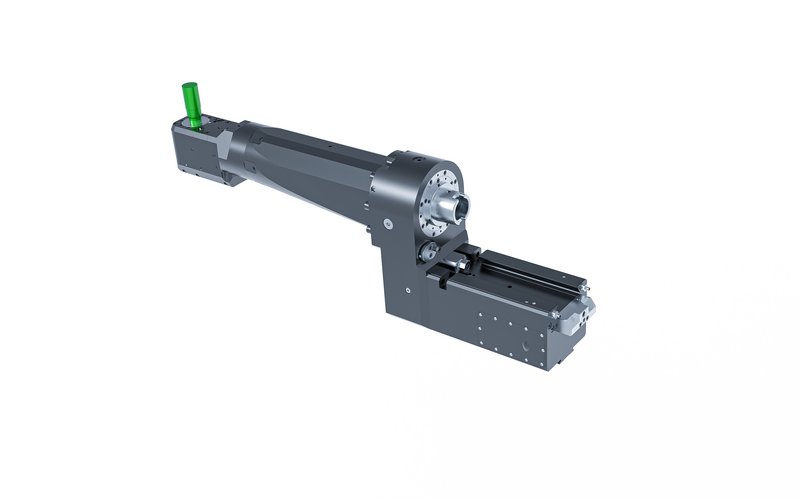
WFL Millturn Technologies is consistently driving the development of complete machining forward and, with a newly developed high-performance angular head, is introducing a key technology for the cost-effective internal machining of complex components. For the first time, this innovation enables fully automated, process-reliable, and highly productive machining of demanding internal geometries—particularly in thin-walled aluminum components—in a single setup.
Internal machining is one of the most technologically demanding areas of machining. Long overhangs, limited accessibility, challenging chip removal, and high demands on stability and accuracy pose challenges for machines, tools, and processes alike. WFL has been addressing these requirements for years with a holistic approach: Instead of isolated technologies, the focus is on the perfectly coordinated interaction of machine design, tool interfaces, process monitoring, and machining strategy.
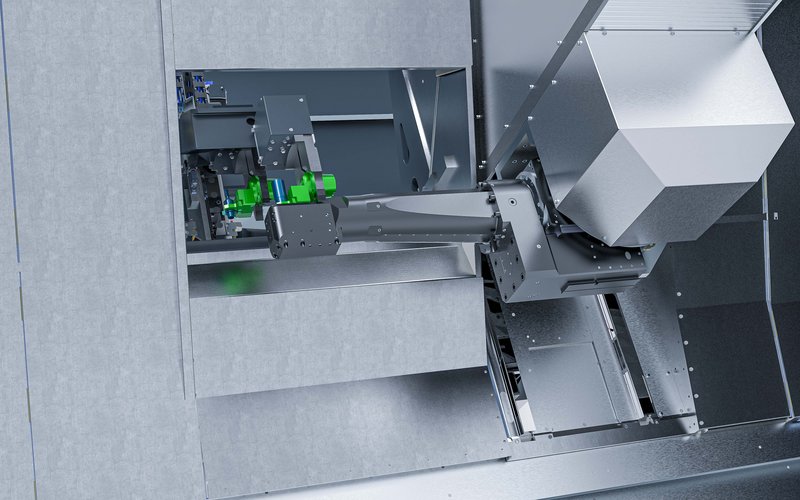
The new angle head significantly expands this integrated overall concept. The focus is on highly productive internal milling with rotating tools directly inside the component—an application area that is steadily gaining importance, particularly for large-volume lightweight aluminum structures.
Automation as the Key to Productivity
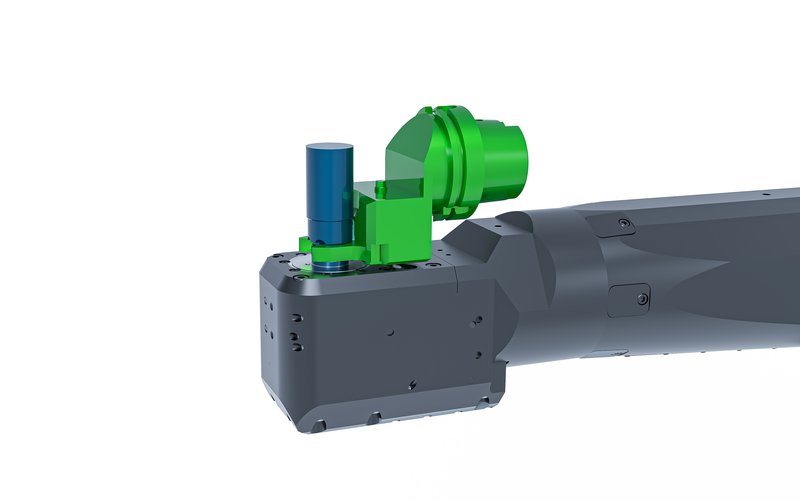
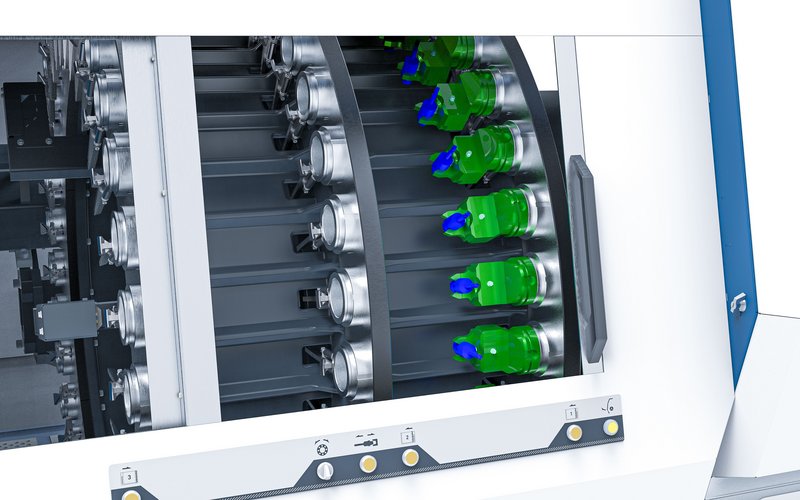
At the heart of the development is a specially designed tool interface based on HSK-A32, which for the first time enables automatic tool change directly within the angle head. Unlike conventional solutions, where tools must be clamped manually in the unit, tool change is fully automated via the machine’s standard tool magazine.
An integrated hydraulic clamping mechanism handles the precise clamping and release of the tools. Using suitable adapters, standard HSK-A32 tools can be used in a 90° orientation. This allows even complex machining processes involving a large number of different tools—over 20 in specific applications—to be carried out without manual intervention.
The result: significantly reduced setup times, minimized downtime, and significantly increased process reliability—crucial factors for cost-effective series production.
High Speed Meets Process Stability
A key focus of development was the system’s speed capability. Especially in aluminum machining, high cutting speeds are essential to achieve economical cutting rates. At the same time, continuous operation and thermal stress place the highest demands on bearings and lubrication.
The new WFL angle head achieves speeds of up to 12,000 rpm in continuous operation. This is made possible by a specially developed oil mist lubrication system that ensures stable temperature control and a long service life for the bearings. The necessary media supply—hydraulics, electrical power, and lubrication—is transmitted directly into the unit via an integrated rotating interface.
This combination of high-speed capability and robust construction creates the conditions for consistently stable high-performance machining.
New machining strategies through intelligent kinematics
In addition to its mechanical design, the angle head also opens up new possibilities in machining technology. In combination with the machine’s simultaneously interpolating B-axis, innovative machining strategies can be implemented.
One example is the production of internal radio: Instead of conventional strategies using ball-end mills and many narrow feed paths, the angle head is swiveled precisely. This allows for the use of larger tools that produce the desired geometry with significantly fewer passes. This significantly reduces machining time—while maintaining high surface quality.
This intelligent use of the machine’s degrees of freedom exemplifies how significant efficiency gains can be achieved through the interplay of mechanics and strategy.
Optimized for thin-walled lightweight structures
The development of the angular head is specifically aimed at machining thin-walled aluminum components. Such components are often produced from solid blanks that are drastically reduced in size during machining—for example, from over 100 kg to a final weight of just a few kilograms.
The resulting delicate structures are extremely sensitive to cutting forces. At the same time, cost-effective processes require high material removal rates and cutting speeds. The new angle head addresses this trade-off with a combination of high rigidity, controlled force transmission, and stable process control.
In addition, customized clamping concepts and integrated measurement cycles for component monitoring are used to minimize deformation and ensure the highest component quality.
Part of a holistic complete machining concept
The strength of the solution lies not only in the angle head itself, but in its integration into the comprehensive WFL technology concept. This ranges from deep-hole drilling and internal turning through demanding processes such as bottle drilling to highly dynamic internal milling.
All processes are designed for complete machining in a single setup. This eliminates the need for re-clamping, reduces cycle times, and significantly increases component accuracy.
Conclusion
With the new high-performance angle head, WFL sets another milestone in internal machining. The combination of automatic tool change, high-speed capability, integrated fluid supply, and innovative machining strategies enables a new dimension of productivity.
Complex internal geometries, which were previously considered technologically challenging or economically borderline, can now be manufactured stably, reproducibly, and efficiently—fully automated, in series, and on a single machine.