
Niehoff relies on autonomous precision manufacturing with WFL MILLTURN

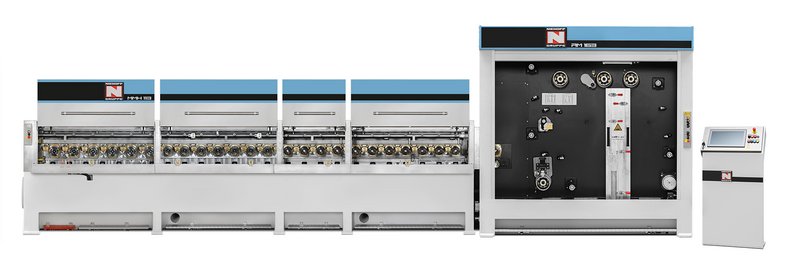
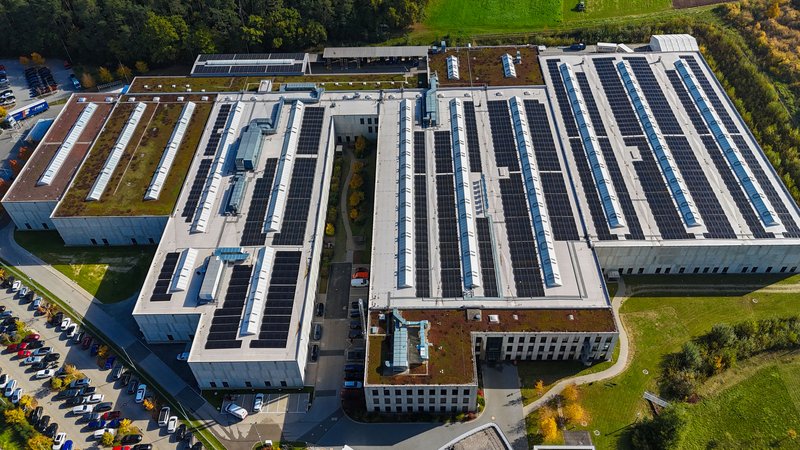
Maschinenfabrik NIEHOFF GmbH & Co. KG, headquartered in Schwabach near Nuremberg, is one of the world’s leading manufacturers of machinery for the wire and cable industry. As a technological pioneer, the company develops and manufactures highly specialized equipment for wire and cable production—ranging from drawing machines and annealing systems to braiding and stranding machines. With approximately 1,200 employees worldwide and about 700 at its two German locations, NIEHOFF is considered a classic “hidden champion” in its industry. The company’s products form the foundation for numerous applications in modern life. Whether data cables for digitalization, power cables for infrastructure, or cable systems for electric mobility—wherever electricity or data is transmitted, NIEHOFF’s technologies play a crucial role. Against this backdrop, the highest quality standards and absolute process reliability are indispensable. That is precisely why NIEHOFF decided to invest in a new automated WFL MILLTURN solution.
Strategic decision to increase vertical integration
To further expand its technological expertise and embed valuable manufacturing know-how within the company for the long term, NIEHOFF decided to integrate the production of a key precision component into its own manufacturing operations. The goal was to strengthen process expertise, increase value creation, and fully control the quality of a core component that is critical to overall quality. These components are crucial to the performance of the systems and must meet the highest requirements in terms of dimensional accuracy, concentricity, and process reliability. “We wanted to bring that knowledge and expertise in-house,” the company explains regarding the reasons for the investment.
Complex components in a single setup
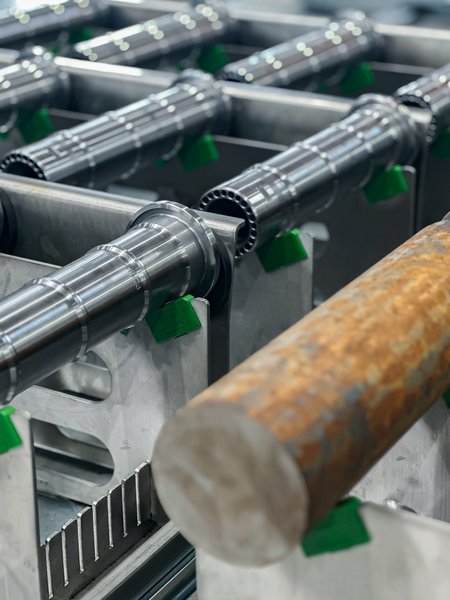
The automated MILLTURN machine is used to manufacture drawing shafts and the high-precision sleeves mentioned above. Together, these components form key assemblies in NIEHOFF’s drawing machines. They are manufactured from various heat-treated steels, such as 42CrMo4V.
Particularly challenging are the high precision requirements as well as deep blind holes with closed bottoms. Bore depths exceeding seven times the diameter must be achieved with the highest precision.
In addition, extremely high-quality requirements are placed on the finished workpieces:
IT6 fits
Concentricity of 0.005 mm
and roundness tolerances on bezel seats of less than 2 µm
These values must be achieved reliably and without operator intervention.
Customized Automation Despite Limited Space
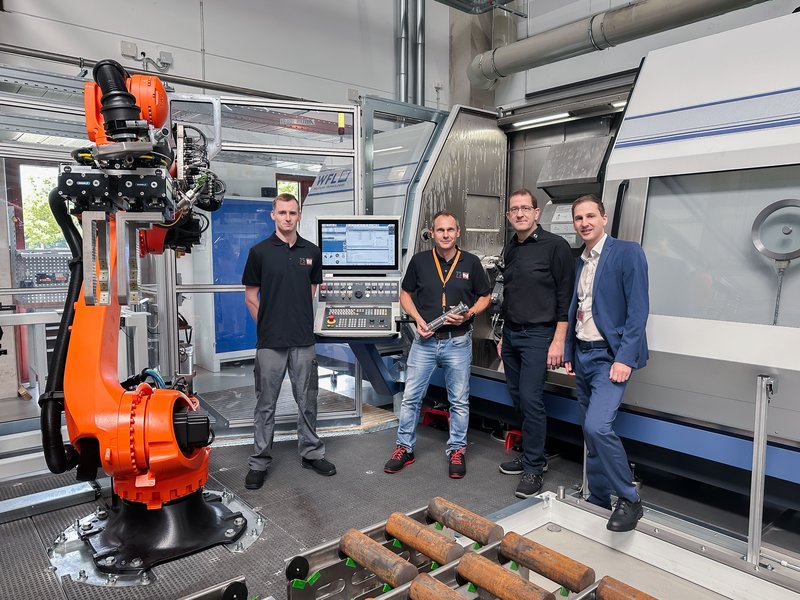
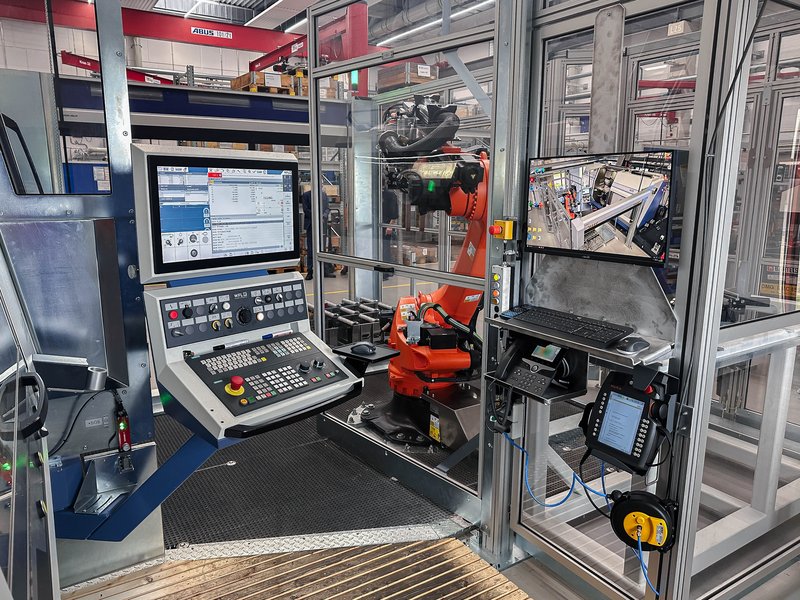
A key criterion for investing in the M35 MILLTURN was the integration of automation into a production environment where space was already severely constrained. Together with WFL Automation Solutions, NIEHOFF developed a system layout precisely tailored to the available space. The result is an extremely compact automation solution that makes optimal use of the available space while still providing sufficient room for the operator. The open and bright design of the automation cell enables both automated operation and quick manual interventions for individual parts or spare parts orders.
Automation is cost-effective even for small batch sizes
Batch sizes at NIEHOFF typically range from 1 to 50 pieces. Small production runs are particularly necessary for replacement parts. At the same time, the company wanted to take advantage of unmanned production. The solution was found in a fully automated MILLTURN system with robotic loading. Workpieces are automatically fed into the system, fully machined, and then discharged. This enables unmanned machine operation across two full shifts. The combination of automation and flexibility was crucial for NIEHOFF: “A full-fledged MILLTURN for manufacturing complex parts and, at the same time, a fully automated machine for unmanned production at night.” Thanks to the intelligent operating and automation concept, even small batch sizes can be set up quickly. The system thus combines high flexibility with the advantages of automated production—even with frequently changing orders.
End-to-End complete machining increases productivity
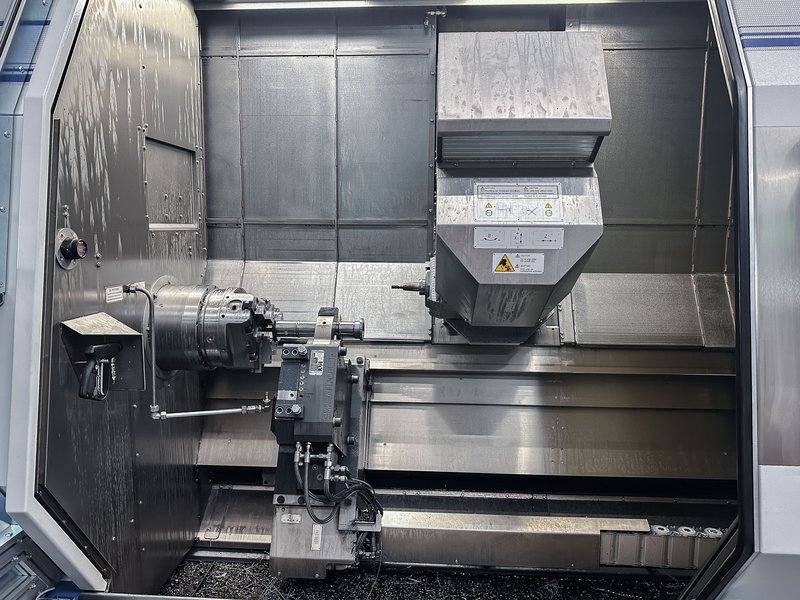
A key advantage of the new solution lies in its consistent end-to-end complete machining. The workpiece is fully machined in just two setups. The change of clamping jaws that would normally be required was avoided thanks to an innovative special clamping jaw—a combination of a claw jaw and a turning jaw. This made it possible to automatically turn the parts during the ongoing process.
For NIEHOFF, this approach represented another important step forward in development.
While the actual machining time for a workpiece remains comparable to that of previous production on an older MILLTURN, the entire manufacturing process has been significantly accelerated. Key factors contributing to this are automated workpiece handling, reduced setup times, the specially developed clamping jaws, the resulting ability to perform unmanned night production, and increased process reliability. This significantly boosts overall equipment effectiveness.
Intelligent solutions reduce sources of error
NIEHOFF placed particular emphasis on ensuring safe and reproducible changeovers.
As part of the robot cell development, NIEHOFF implemented a database for clamping jaws. Zero points no longer need to be entered manually. Instead, all workpiece-related values are automatically collected from parameter values within a central database, the resulting zero point is calculated, and this information is made available to both the machine and the robot controller. Changes to clamping jaws are stored centrally and thus automatically applied to all relevant processes. This has significantly reduced the risk of errors during changeovers.
Digitalization and process monitoring at the highest level
Manufacturing at NIEHOFF is characterized by a very high degree of digitalization. Programming is carried out entirely without a CAM system. Instead, approximately 120 in-house developed machining cycles are used, incorporating decades of manufacturing expertise. Before production begins, all programs are thoroughly checked for collisions using the VERICUT simulation software.
For additional process monitoring, the company uses modern technologies such as angled 3D probes with a 1-mm probe ball, laser-based length measurement of raw parts, and integrated quality controls during machining, as well as WFL’s proprietary iControl system for tool monitoring. These solutions ensure maximum process stability and enable the required unmanned production.
Long-standing partnership as a basis of trust
Another decisive factor in the investment was the company’s long-standing experience with WFL.
An M40 MILLTURN has been in successful operation at NIEHOFF since 2007. The positive experiences regarding long-term accuracy, reliability, and service significantly influenced the purchase decision. Particular emphasis is placed on the fast and competent support provided by WFL Service: “For 20 years, we have been accustomed to excellent WFL service, which naturally influenced our decision to purchase another MILLTURN.”
Sustainability in practice
NIEHOFF also consistently pursues a holistic approach to sustainability.
Standard features include controlled drives for pumps and fans, centralized water cooling, heat recovery, geothermal energy for machine and cooling lubricant cooling, low-energy buildings, and a 1-MW photovoltaic system. At the same time, the company is consistently advancing digitalization. Today, production documentation is almost entirely available in digital form.
Conclusion
With its investment in the automated WFL MILLTURN, NIEHOFF has taken another important step toward highly flexible, cost-effective, and future-proof manufacturing.
The combination of complete machining, intelligent automation, high long-term accuracy, and unmanned production enables the company to manufacture even the most demanding precision parts efficiently and with consistent results. At the same time, the solution provides the necessary flexibility for small batch sizes and spare parts production. NIEHOFF’s concluding summary sums up the advantages: “The MILLTURN impresses with its high process stability, which makes it possible to consistently reproduce precise results even without operator intervention. The well-thought-out operating concept, combined with the high long-term accuracy of a MILLTURN, guarantees many years of cost-effective production at the highest level.”