
Pre-development and Testing: Between Idea, Machine and Customer
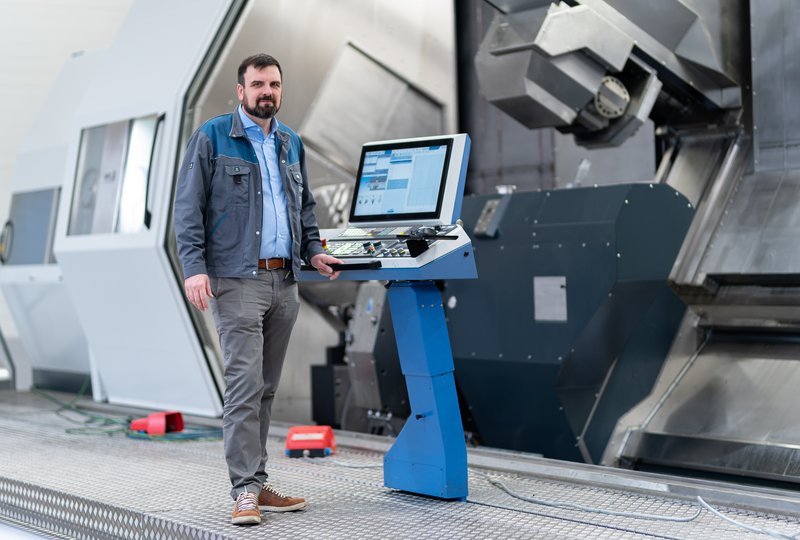
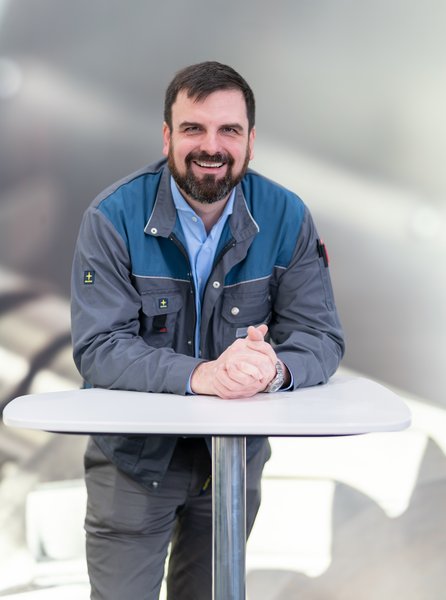
Günther Siegwart’s field of work lies at the intersection of ideas, market requirements and technical feasibility: in testing. He knows that only by testing ideas under real-world conditions can one develop truly robust, field-ready solutions. In our interview, he provides an insight into his day-to-day work, the challenges of the testing world and why patience and customer feedback are among the most important tools.
What do you focus on in pre-development – and how does this differ from traditional Research & Development?
Siegwart: Pre-development involves exploring the technical limits of a system and identifying the physical operating principles best suited to a particular problem. Typical questions include: Can an ultrasonic inspection be implemented on a MILLTURN? Which technical systems are suitable? Ideally, I test the concepts in preliminary trials before they move on to detailed development. I also deal with market studies and customer requirements.
What makes experimental work particularly exciting for you?
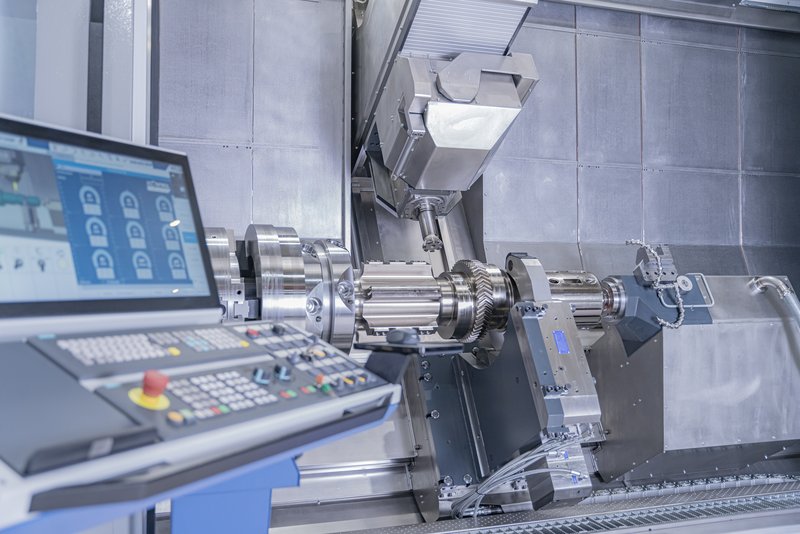
Siegwart: The high practical component. I spend around 40 to 60 per cent of my time directly at the MILLTURN. There, new assemblies are tested, performance limits are explored and components are tested under extreme conditions. The aim is to ensure that new solutions not only function under ideal conditions, but are also reliably durable and can later be incorporated into the product portfolio without hesitation.
Can you give some examples of such tests?
Siegwart: A current example is the testing of a MILLTURN motor spindle with a speed of 20,000 revolutions per minute – this speed must be reliably achieved and maintained under real-world conditions. This also includes long-term tests of other components such as chain magazines, hydraulic actuators, etc., lasting from several weeks to several months. In doing so, we examine factors such as wear and operational behaviour, service life and thermal stability.
What technological topics are currently the focus of attention?
Siegwart: At the moment, I am working on, among other things, performance turning tests, the contour accuracy of a B-axis swivel gearbox and grinding tests, as well as the operational behaviour of various cooled attachment tools. Another topic is a new concept for collet adjustment under load, which is currently being implemented in collaboration with the design department. Challenges relating to purchased parts also play a major role in my day-to-day work. Here, I work closely with suppliers to find satisfactory solutions for all parties involved in the value chain and for our customers as end-users.
What types of tests do you carry out on MILLTURN machines?
Siegwart: The tasks essentially fall into the following categories:
Performance and stress tests to analyse the thermal behaviour of individual components. A thermal imaging camera and various temperature-measuring devices are used for this purpose. Typically, a test setup is constructed and then examined to determine which components are subject to particularly high thermal stress, whether the cooling system is balanced, whether voltages or noticeable temperature gradients arise within the assemblies, and what cooling capacity is required from the cooling unit.
Secondly, investigations into the machine’s geometric behaviour during metal cutting or the resulting displacement caused by the thermal influences described above.
Thirdly, optimisations in the area of control and regulation, in which the system is deliberately pushed to its limits through parameter variation in machining tests, so that the ideal operating points for an assembly or a process can subsequently be derived.
What are the biggest challenges here?
Siegwart: One of the biggest challenges is to fully grasp a problem intellectually whilst at the same time not losing sight of a solution that can be realised within the given system limits. Sometimes, the search for the right lever to pull is like Sisyphus’s labour, particularly when dealing with complex vibration issues. There are moments of frustration, but also great feelings of achievement when a technical challenge has been solved in a sustainable way. It is important not to merely treat the symptoms, but to eliminate the root cause of the problem permanently. Prerequisites for the work include, alongside a sound theoretical understanding of technical interrelationships, curiosity and a commitment to lifelong learning, as well as a certain resilience and tenacity.
Often, Plan A is not feasible in practice, even if the solution appears logical on paper. There is a constant conflict between theory and practice. For example, because factors may come into play that were not considered in the theoretical analysis or whose significance was underestimated beforehand.
What does your day-to-day work involve?
Siegwart: 40% involves interventions for project-related issues, a further 40% involves field testing of components from Research & Development, and 20% consists of theoretical feasibility or market studies.
What has been the biggest lesson you’ve learnt in your career so far?
Siegwart: The most important lesson I’ve learnt in my career so far is to take the customer’s perspective very much into account right from the Research & Development stage. In the Research & Development office, there is a tendency to apply and solve problems on the assumption of idealised conditions. However, for a product to be fit for the field, it is essential to take production conditions, the end-user’s perspective and even foreseeable operator errors into account right from the design phase: how resilient does the solution need to be to be truly fit for the field? Discussions with fitters and users are therefore essential.
What trends do you see in turning, drilling and milling technology and complete machining?
Siegwart: Machines must become increasingly reliable whilst also being easier to operate – and not solely because of the increasingly acute shortage of skilled workers. Smart automation solutions and user guidance are becoming far more important. Consequently, topics such as digital products, AI-supported assistance functions, or predictive maintenance based on pattern recognition of the operating data available as by-products in the machine tool sector will offer significant added value in the future. Even if many of these applications are still purely visionary due to the greatly overestimated state of the art.
Do you have a personal vision for your future at WFL?
Siegwart: The silo mentality established in mechanical engineering must be broken down. I would like to see an even more holistic approach to Research & Development. Mechanical engineering, control and electrical engineering, installation and Applications Engineering must work together on solutions right from the start. The early involvement of all disciplines promotes elegant, lean and practical solutions, which are given less scope in a Research & Development organisation operating according to the waterfall principle.
What helps you recharge your batteries in your spare time?
Siegwart: My partner, hiking and spending time in nature.